Showing posts with label license. Show all posts

Should We Wait for Patent to License?

Dear Rich: Our company has a product idea which has been professionally prototyped/tested and we have acquired a trademark. It is patent pending for the past 2.5 years and should be up for finalization within 6 months. It relates to a fashion technology and our intent is to try to license the technology to existing brands. I am concerned that potential customers (brand) could lose a sense of urgency if they have to wait for the patent to be finalized? As you know, there is always a chance a patent can be denied, delayed, or disputed. They could also look for workaround’s on the patent or possibly seek deals with like technologies already available. Due to the risks and costs involved, I have opted to license the technology instead of producing a line ourselves. Had we been in a manufacturing position, we would have produced our product under Patent Pending status. As we don’t have production facilities or know-how, serious cash flow, nor distribution channels we have opted for a licensing model. Should we wait for patent finalization before trying to license the technology out? We can't advise you what to do but we do know that many people in your position do not wait for a patent to issue before pursuing a license. Often that decision depends on the industry. For example, in the toy, entertainment and fashion industries, speed to market may be the most important variable, with proprietary rights being a second perhaps less important concern. You probably are aware that there is no legal protection for your technology until the patent issues. Because 18 months have passed, your patent may have been published by the USPTO (depending on whether you permitted publication) so you can take advantage of one protective aspect of patent law. Anyone who copies your invention now, before the patent issues, can be subject to infringement for past transgressions once the patent is granted, provided you place them on notice regarding your patent pending status. We talk about that more here.
Evaluation agreements. Most people in your position use evaluation or option agreements with potential licensees. These agreements allow someone to evaluate the potential, and if they like your stuff, to make a deal. If your application has not been published you will need a nondisclosure agrement (or some variation) as well.
License agreements. Because there is always a possibility that a patent will not issue many people in your position enter into licenses with a two-tiered royalty. (Here is some basic invention licensing information). If the patent issues, you receive one royalty; if the patent does not issue, you would be entitled to a lower royalty. There are numerous ways these agreements can play out and we've outlined a few of the scenarios in one of our books.

Who Owns Copyright in Piano Arrangements?

Dear Rich: If a sheet music publisher wants to license my songs for a folio (a collection of all songs from an album), with the proviso that their particular, notated piano arrangements of my songs are being created as a work-made-for-hire for me, then can the sheet music publisher nevertheless claim copyright in the overall folio as a collection? Or to phrase my question a bit differently: Is the copyright in a collection a "derivative copyright," which I would have to expressly grant to the sheet music publisher? Speaking of sheet music, we recently downloaded sheet music from Appetite for Destruction by Guns N' Roses (the 11th best-selling album of all time) from Musicnotes.com. Wow, the world has come a long way. We can't prevent world hunger or predict earthquakes but we can get the guitar tabs for Welcome to the Jungle in a few keystrokes. Yea!
Right, you had a question. We're going to assume that you granted the sheet music publisher exclusive rights to publish the portfolio. In that case, the publisher (as exclusive licensee) is considered the “copyright owner” of that collection of sheet music and has the right to register the collection and to file an infringement action in court to stop a rival sheet music publisher who rips off the portfolio. In reality, the rights acquired by the copyright owner are narrow because the sheet music publisher doesn't own copyright in the songs or their arrangements -- that's yours. What the folio publisher owns is the equivalent of a "thin copyright" -- a work that contains limited copyrightable subject matter. The key to the publisher's ability to claim its copyright is that the license you granted is exclusive. A non-exclusive license won't cut it.
Do you have to expressly grant a derivative copyright? No, not exactly, but you do have to grant the exclusive license which automatically gives rise to the publisher's ability to register its rights and pursue thieves. The agreement may also modify the rights and relationships of the two parties. So, you could request that if the publisher is going to go after someone that you be notified immediately so that you can also pursue the infringers as well. You can also request to be asked to be named on any copyright filings and of course, once the license ends, all rights revert to you.


How Do I License Information Designs?

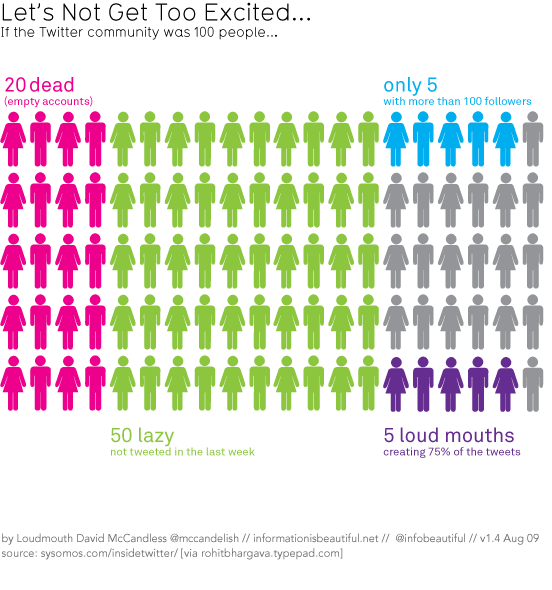
Dear Rich: I have created several information designs in the past few years in the hope of seeing them improve commercial communication. I have the additional hope that they could be licensed and generate a little royalty. Is there a company like the Copyright Clearance Center which might work for me? Do I have to PAY a lot up front, especially to an attorney? We think we have a rough idea what information design is all about and we assume that you're talking about licensing specific information design works (for example, things like this or this) and not the underlying tools, elements or processes used to create your designs. These types of works could possibly be licensed through CCC under their RightsLink program (which does not require an attorney's help.) (And of course, you would need to provide a format that contains the various works -- a website, book, or other collective work -- to enable the viewing of your works.)  Organizations such as CCC will manage license arrangements and collect fees but they don't actually bring in the licensing customers. That's still your obligation, either via web traffic or old-fashioned solicitations. To that extent, if you can find licensees on your own, you probably don't need an organization's services and can license directly to customers. You can find plenty of examples of license agreements at Nolo's website or through other sources.

Can I Prevent My Photos From Being Modified?

Photo Week #3
Dear Rich: I sold some Italian street photos to an ad agency and they Photoshopped two of the streets together in one photo for an ad. What can I do to prevent things like that? It all depends on the sales agreement. If you sold (assigned) the copyright with no strings attached, the new owners (the ad agency) can do whatever to the photos. If you want to prevent those types of modifications, your agreement would prohibit any modified (or derivative) versions unless approved by you. Alternatively, if your agreement provides for a photo credit, you can also request the right to remove your credit if you don't like the result.
Bargaining Power. Asking for approval and removing credit sounds fine but practically we doubt whether many photographers have the bargaining power to get these provisions. Of course, it doesn't hurt to ask. But in a world in which companies want to own everything, photographers usually have to give up on approvals, etc. (That's not always the case outside the U.S. where artists have moral rights.) By the way it's easier to prohibit modifications if you license the photos -- this article explains the difference between assignments and licensing.
Today's public domain photo: by Ansel Adams, a 1943 image  of children at Sunday school class at the Manzanar Relocation Center in California. (You can see more of these Ansel Adams photos here and here.)

Royalty or Equity for Copyrighted Character

Dear Rich: I am being asked to work as creative director for a new entertainment company that is just starting. The plan is that this company will have one principal entertainment property that hinges on a main character (a cartoon), with the goal of creating a desirable licensable image and personality (via online episodes and games, and eventually consumer goods). That will hopefully lead to startup funding. I am currently collaborating directly (without compensation) with the founder of the company to co-create this character by providing art and writing. I will eventually be the principal individual in charge of directing her image, voice, and evolution and once the company is funded, I will be offered to join as an employee with full-time salary as part of the employment package. I am also being offered a percentage of equity in the company. The founder's goal is to sell the company (in the internet/Silicon Valley tradition) once the revenue from licenses, etc. is established. The founder and I have discussed the possibility of future royalties as an incentive but we don't have a good idea as to a standard for this. A big concern for the founder (and shareholders) is burdening the sale of the company with an ongoing commitment by the acquiring party to pay an individual (or individuals, in the event the founder also has an interest in a royalty stake) in perpetuity. This sounds non-standard for what we know of the internet industry. But perhaps it is not that unusual and we are just unfamiliar? Sometimes the Dear Rich staff imagines what life would have been like if we (not Peyo) had created the Smurfs -- the licensing possibilities, the interaction with our adorable blue friends, and most important, knowing that we're leaving behind a lovable legacy. We're not saying we'd be happier or more fulfilled -- there's a limit to the satisfaction provided by licensed characters, and we imagine there's also considerable stress -- but things would definitely be different if we surrounded ourselves with Smurfdom.
Right, you had a question. You're kind of in the position of a pre-Smurf Peyo. We admire your business planning and strategizing (as General Eisenhower said, "plans are useless; planning is indispensable") but what you should keep in mind is that while you proceed, legal decisions are being made without you knowing about it. For example, if you and someone else are creating a copyrightable character, then you're both co-authors of that character (once created) under copyright law. No paperwork is required for that to occur. As co-authors, either one of you can license the character provided the other co-author is reimbursed. If you've already created the character, you'll need to deal with (and acknowledge) that fact. Sometimes, this is accomplished by assigning your rights to the venture and once you assign your rights, that's it. You won't be able to get those rights back for 35 years. Alternatively, if you're hired as an employee, and you create the work after becoming an employee, the company will own whatever you create. So, if you haven't created the character then you should probably work out the paperwork before beginning ... so you're not playing catch-up later. At the same, if you and the founder are currently contributing to the business and planning to share in the revenues and you haven't 'created' a company, then you're operating as a partnership, with all of the legal obligations that entails.
What paperwork do you need? It's all about how you will be compensated. Maybe equity -- stock ownership of the business -- will be sufficient. If you acquire stock and the company is sold, you'll probably receive a payment for your shares and that will be likely be that. You're unlikely to receive income from any post-sale revenues (unless that's a condition of the sale of the business). If you're receiving a royalty for your copyright interest, that would continue after a sale because the new owners would have to assume the royalty obligations.
Do acquiring businesses want to assume royalty obligations? As a general rule most companies like to pay once for a business and not to have continuing payment obligations. On the other hand, many acquiring businesses -- music, movie, toy, publishing, and photograph companies --- assume royalty obligations as standard operating procedure. It's no big deal. We believe that if your property is a serious revenue-generator, royalty obligations won't stand in the way of a sale. And we wouldn't worry about a new owner having to pay in perpetuity. When it comes to acquisitions, anything can be worked out if the parties are willing.
Next steps. Document everything. If someone makes you an offer, save the document or email. If you agree to something, put that in writing. If you're in the midst of creating the character or storylines, keep track of who contributed what. Situations like yours are often sorted out after the fact and documentation is essential. If possible, avoid creating your work until the paperwork is in order. That's because if the character is created and becomes a hit, the company will be in a better financial position to challenge your legal rights. That's why the time to get everything right is before creation of the character.